
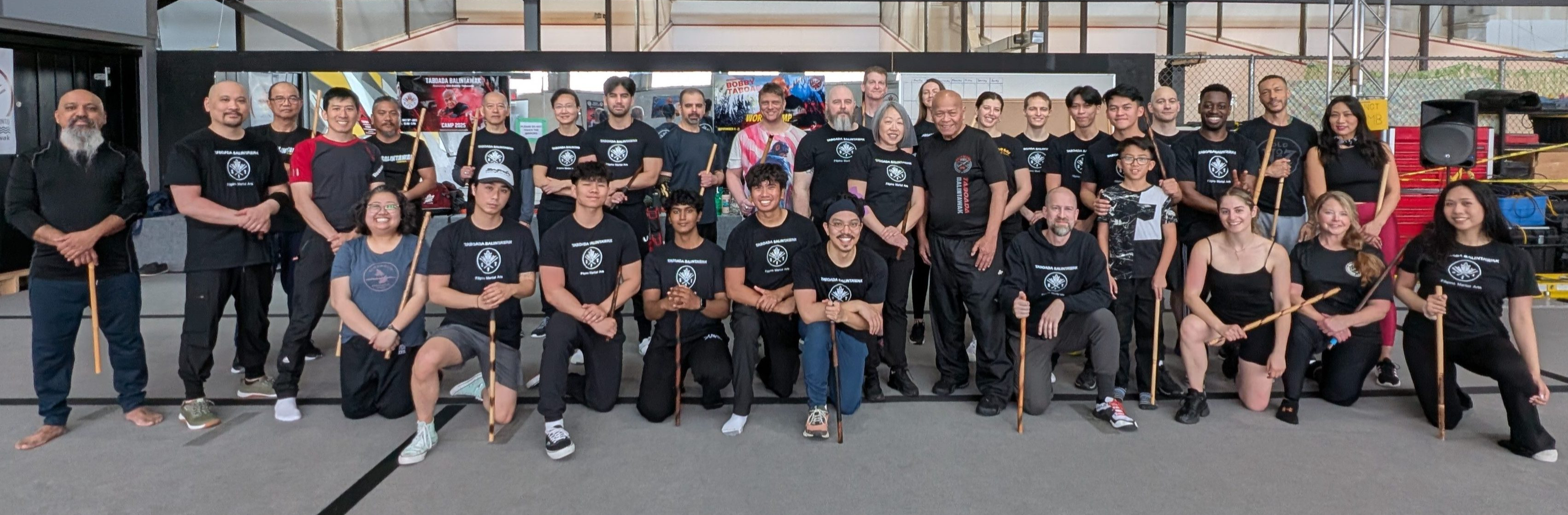
Taboada Balintawak
The Taboada System is built around 12 basic strikes; each strike is paired with a defense and a counter. This is the foundation of Balintawak.
Our skill-drilling system is called Agak. Agak is to Balintawak as focus mitt work is to western boxing. It focuses on developing your speed, power, and control.
In Agak, a senior student feeds controlled strikes to a junior student. The junior student’s form is corrected on the fly as they practice defending and countering each strike.
This drilling process is a lot of fun and creates thousands of reps in a short period of time. Once you understand the fundamentals, you can expect to progress quickly.
The Taboada curriculum is a well-designed process that smoothly progresses you from an absolute beginner and then systematically provides you with all the tools you need to become proficient as a Balintawak practitioner.
If you have no prior martial arts training, it teaches you proper body mechanics. If you do have previous martial arts experience, it improves the speed, reflexes, and sharpness of the other arts you have trained in.
Stick Fighting Toronto Curriculum
The full Taboada Balintawak curriculum is available here. The download portal is on GM Bobby Taboada’s personal website. All prices are in USD.
LEVEL ONE
BASIC MOVEMENTS
AND STRIKES
Level One introduces students to the Taboada system. Footwork, defensive positions, basic striking, blocking, and the Taboada Shadow Fighting Form are covered. These form the foundation for our defensive postures while maintaining the ability to deliver full power strikes with balance and control.
LEVEL TWO
DEFENSE AND COUNTERS
Level Two builds upon the foundation of Level One. Here, we learn how to defend and counter all of the strikes learned in Level One. We study controlled strikes vs. full powered strikes as well as off-rhythm hitting techniques while in stick fighting motion. This develops a student’s awareness of body position in relation to an active opponent.
LEVEL THREE
GROUPING SYSTEM
Level Three focuses on developing stick fighting attributes. Students learn how to lift off and clear target obstructions. Move their heads off the line of incoming strikes. Develop body flexibility, speed, reflexes, and defenses against punches while in stick fighting motion.
LEVEL FOUR
PUSHING, PULLING, BASIC BUTTING
Level Four expands upon the grouping system of Level Three. Here, we learn how to off-balance an opponent with either pushes or pulls using the left hand. Students are also introduced to the short-end or butt of the stick, learning how to strike at the hands, shoulders, or head of an opponent. Combination strikes are also introduced in preparation for Level 6 testing.
LEVEL FIVE
STICK DISARMS
Level Five focuses on removing the stick from an opponent’s hand while in stick fighting motion. There are twelve (12) disarms taught from both the forehand and backhand attacks. Level 5 is also where we must demonstrate stick feeding proficiency as senior students.
LEVEL SIX
COMPLETION OF THE ART (COA)
Level Six brings the concepts and techniques of all previous levels into play as well as ten (10) semi-advanced or fight finishing techniques. Here, we must demonstrate proficiency in feeding all basic strikes randomly, feeding all groupings randomly, and demonstrating all semi-advanced techniques while in stick fighting motion.
LEVEL SEVEN
FULLY QUALIFIED INSTRUCTOR (FQI)
Level Seven is the final level in the Taboada System. In this level, we must demonstrate our understanding of the system by teaching another student Levels One (1) through Six (6). We must further demonstrate our understanding by creating twenty-four (24) semi-advanced techniques (fight finishing techniques) of our own.
The FQI Test consists of four (4) parts: Teaching requirement, 24 Self-developed techniques, Defensive Skill, and Character under pressure. FQI grading tests physical fitness, technical expertise, mental fortitude, discipline, and control.
Stick Fighting Toronto
Taboada Balintawak
Filipino Martial Arts
75 Carl Hall Road
Unit 15
(The Monkey Vault)
North York, Ontario M3K 2B9


© Copyright 2026
Stick Fighting Toronto - FMA
All Rights Reserved
Site provided by Five Rings Strategies